Showing posts with label radio. Show all posts

Saturday, July 3, 2010

Joan Rivers – A Piece Of Work: C

Wow. I can't recall when I last saw a movie in the theater (or when I blogged a review for that matter). Scott and I did see IMAX's Hubble 3D last weekend during our impromptu day trip to the Evergreen Air Museum. We have been watching more movies at home. I probably did miss blogging whatever the last movie I saw, but I haven't been going to the movies as much. There really hasn't been anything compelling us to go out (wow, that sounded middle-aged suburban).

Ma, Scott, Sheena and I saw Joan Rivers –A Piece Of Work at Cinema 21, which is another place I haven't been to in a long time (Good news! They finally accept plastic!). The previews for 9500 Liberty, Countdown to Zero, and Winnebago Man looked promising.

I mainly know Joan Rivers from the praise she regularly receives from Kathy Griffin, her 2009 Comedy Central roast, and her recent Fresh Air interview. Unfortunately, Fresh Air aired the most interesting moments and spoiled the documentary. But it was still interesting to actually see what was happening. That said, I probably would have never heard of the documentary if not for the radio program.

A Piece Of Work follows Rivers through a year and shows Rivers as being painfully self-conscious, professionally narcissistic about her brand/business/career, thankful for her successes, and very bitter about her losses. Rivers' non-stop work schedule at 75 is amazing and while she whines about the unfairness of the entertainment industry (and is a bit excessive at portraying herself as a victim), she seems to enjoy her craft.

Overall, an interesting documentary about a barrier-breaking woman, but not a ground breaking movie. It did drag on a bit toward the end. I hate to admit it, but some TV reality shows like My Life on the D List do a better job of making entertaining documentaries.

Sunday, March 8, 2009

Michael Feldman's Whad'Ya Know?

0306092040.jpg

I dragged Scott to the Whad'Ya Know? taping in Salem on Friday night at the beautiful Elsinore. The show was great! I don't mean this in a negative way, but the show was just what I expected. Just like Wait, Wait, I'm glad I was finally able to see a show live that I've listened so often.

Tuesday, June 10, 2008

Bush Jr's ignorance undermining effective HIV/AIDS programs

(RANT: Just needed to post this rant some place.)

I just heard today's Fresh Air interview with epidemiologist Elizabeth Pisani on the HIV/AIDS epidemic. She carefully credits the Bush Jr. Administration for boldly funding AIDS treatment in Africa. However, she also strongly criticizes the abstinence-only dogma tactic that is undermining the fight against HIV/AIDS.

Pisani has published a new book The Wisdom of Whores: Bureaucrats, Brothels, and the Business of AIDS. A blog entry the book's website includes some of her criticisms of US policy:

Treating our failures

As Think Progress and CREDO pointed out, George Bush shouldn’t have been quite so smug in his State of the Union address. They list some of the ways that US money is undermining progress against HIV. But I’m afraid they’ve missed some other gems that the administration has thrown up in the way of effective HIV prevention.

One is the Loyalty Oath. Different from the gag rule, the Loyalty Oath prevents organisations that accept any funding from the US from working constructively with sex workers, because it prevents us from recognising sex work as a legitimate way of making a living. The restriction applies not just to US money, but to ANY money. i.e. if a government accepts US money to do abstinence programmes, it is not allowed to use its own taxpayers’ money to improve working conditions in the sex trade. Some governments have the balls to treat this violation of their sovereignty with the contempt it deserves. Brazil, for example, turned down US$ 40 million dollars of US “aid” money for HIV prevention because it wanted to continue to engage prostitutes in prevention programmes as grown-ups making independent economic choices, rather than as simple victims of trafficking.

The second is the prohibition on spending money on clean needles for injectors. In most of Asia and much of Latin America, drug injection is the major driver of HIV infection. It has recently surfaced as well in Nigeria, South Africa and Tanzania, which are already struggling to deal with sexual infections. Sterile needle programmes are one of the most effective, and cost-effective, HIV prevention strategies. But under current US policy we can’t use them. We’ll give expensive, US-made pharmaceuticals to people once they are infected, but we won’t stop them getting infected in the first place. Go figure.

We won't let countries use their own money to develop their own programs? Yet, again, the Bush Jr. has an incredible talent of alienating and demeaning people and governments around the world.

Like the way he arrogantly divided the world after 9/11; like Bush Jr. at-best ignorant and at-worst criminal decision to needlessly invade a country; like his failed economic, environmental, energy, education, and auto industry regulations that have left us in ruins; Bush Jr. & Co.'s HIV/AIDS isn't about listening to experts and developing effective policy. Instead, Bush Jr. was about placating the religious right and enacting some right-wing dogma into government policy. Not sure there is any more to say other than to keep watching that counter on my blog and maybe give a few extra bucks to Obama and the Democratic Party.

Thursday, August 30, 2007

OPB & anti-gay politics controversy

Sometime last week, I began hearing OPB's ads for the Ira Glass's upcoming appearance in Portland . . . er, Clackamas. I was surprised to hear he would be speaking at the suburban mega-church New Hope. I attended New Hope in junior high during the late 1980s and know it to be very active in anti-gay politics, so it seemed like a very unlikely venue. Yes, logistically, New Hope is an attractive suburban venue with a large sanctuary, comfy pews, good sound, plenty of parking and easy freeway access. However, conservative, suburban, Clackamas? It doesn't seem like the stereotypical progressive-leaning, urban, public radio audience venue.

After reading a Metblogs.org entry about Sienna Architecture's business with New Hope last weekend, I sent a whiny late-night complaint to OPB.org:

I was very surprised and disappointed to hear that OPB is presenting the Ira Glass event at New Hope Community Church on October 7, 2007. New Hope is a politically-active organization that actively opposes gay rights legislation and regularly hosts politically conservative events. While I support OPB radio and am a fan of Ira Glass, I would not feel comfortable entering New Hope's facility especially at this politically sensitive time.

I suspect many OPB listeners and Ira Glass fans would have similar reservations about the New Hope venue. Can OPB assure event attendees that they will not be soliticited political petitions at the venue. If not, will the venue allow opposing political views at the event? Can OPB assure that event fees will not benefit New Hope's political activities?

Thank you for consideration.

I hate writing whiny e-mails and had second thoughts about whether I was making a big deal about nothing. I received a response Monday afternoon (underline added):

Thank you for emailing us about the Ira Glass event. I'm sorry that our choice of venue for the event is causing you distress.

The New Hope Community Church was the only space available of the size we needed for the date that Ira would be able to come to Portland.

I certainly understand that you disagree with their political outlook. Given the large and diverse audience we serve it is inevitable that there will be conflicts of opinion. I believe one of the values of public broadcasting is that it helps create a space where conflicting beliefs can respectfully co-exist.

The hall rental is not an endorsement of the church or it's political viewpoint. The church is not a co-sponsor and will have no part in the program. If they have material in the lobby (such as they do for youth groups and other activities) it is not part of the OPB event.

I hope that you consider attending.

Please let me know if I've addressed your concerns. Thanks for your support.

So in other other words, no. New Hope may very well have anti-gay signature petitions as reported by the Merc and no, OPB cannot guarantee that the ticket sales will not benefit New Hope's political activities. A disappointing response, but I resigned myself to thinking, 'well, I tried'. However, I apparently was not the only annoyed Ira Glass fan. Portland Mercury reports that Roey Thorpe sent complaints to OPB last week and Lelo in NoPo has also been leading an effort to have OPB change the venue.

Yesterday, Ira Glass's agent, Steven Barclay, apparently announced that Glass had requested that OPB request a change in venue (although last night OregonLive reported that OPB would not change the venue). Today, the Merc confirms that Ira Glass will not appear at New Hope.

What is most disturbing is that OPB handled their screw-up so poorly. First, why in the world would they do any business such a controversial, political organization? Secondly, instead of admitting they screwed-up, OPB tried to defend their unpopular and offensive decision. Now that OPB is changing the venue, it seems that an apology would be in order and some guarantee that OPB will do a better job choosing who it associates with.

Tuesday, July 3, 2007

Alan Johnston freed!

Alan Johnston banner

Finally some good news from the Middle East: Alan Johnston was freed today!

I've been following the BBC reporter's captivity on the BBC Radio's World Have Your Say call-in show. They have devoted a segment of each day's show to airing pleas for his release and messages of support.

Although I know nothing of Alan or the events surrounding his kidnapping, I admit to getting caught-up in his plight. The initial weeks of silence about whether he was even held captive and the recent images of him attached to a bomb were disturbing.

In typical British understatement, Johnston described his violent captors as "often rude and unpleasant, as you can imagine."

I had wondered if he was able to hear the offers of support on Have Your Say. I'm so glad to hear he did:

I am hugely grateful to all the people - an amazing number of people that worked on the Palestinian side, the British government, the BBC from top to bottom, and a huge amount of support from BBC listeners and viewers.

I had a radio almost throughout, and was able to follow all the extraordinary level of support and interest in my case, and it was a huge psychological boost.

I had added the Alan Johnston button on the blog a few weeks ago, but admittedly wondered when the appropriate time would be to take it down. I'm now gladly removing the Alan Johnston button from the blog.

Thursday, June 28, 2007

Wait, Wait at the Schnitz

'Wait, Wait' at the Schnitz

Here's some of Scott's pictures:


IMG_3988
Originally uploaded by sweber4507


IMG_3960
Originally uploaded by sweber4507

Scott and I just got back from the taping of Wait, Wait...Don't Tell Me at the Arlene Schnitzer Concert Hall this evening. As a regular Wait, Wait listener, I've been anticipating tonight ever since I missed their last Portland visit a few years ago. I think Scott had a good time -- although I had to explain which of the boring Saturday public radio programs this was before hand.

The taping was really interesting. Surprisingly, the live taping is not very different than what makes the air. The pace is slower, but there was more banter with the audience. I heard many in the audience share their disappointment that Paula Poundstone was not on the show. But it was great to put the familiar voices to the faces of Peter Sagal, Carl Kasell, Roy Blount, Jr., Amy Dickinson, and Adam Felber. Peter Sagal sounds so calm and rehearsed on the show, I was surprised how much he danced around his podium and gestured. The celebrity guest was Columbia Sportswear's "One Tough Mother" Gert Boyle. I can't wait to hear the show on Saturday.

Tuesday, June 19, 2007

The Iraq War and 'Don't Ask, Don't Tell'

Fiasco

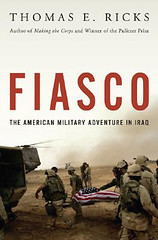
In today's Fresh Air broadcast, Terry Gross interviewed Thomas Ricks. He wrote the bestselling book, Fiasco: The American Military Adventure in Iraq. As always, Terry found the interesting gay angle to the interview and asked Ricks about Don't Ask, Don't Tell. Ricks argued strongly against DADT and made some excellent points:(emphasis added):

THOMAS RICKS: . . . My concern is this, the best way to counter a roadside bomb – and that’s the thing that causes most of our casualties in Iraq – the best way to counter a roadside bomb is not some high technology, electronic jammer, or overhead aircraft. The best way to counter a bomb is to speak Arabic – to be able to listen to people. Maybe they say it directly to you. Maybe they say it to each other as you’re walking by. Maybe they say, “Boy, those troops are headed straight for that bomb that guy just planted”. It would be nice to be able to hear that. Well, American troops don’t speak Arabic. By kicking out people who speak Arabic, I think that some American casualties have directly resulted from that action. If we have more people on the ground who speak Arabic, you are going to save more American lives.

The second thing that really bothers me about this is that you hear people say, “Maybe we should change the policy, but it’s the wrong time to change the policy. You don’t change the policy in the middle of a war.” Well, that’s just historically ignorant. The times when US policies change tend to be in the middle of a war when manpower is most needed. So, for example, it was during the Korean War under Harry Truman when you had large scale integration of black troops into – out of segregated units in – across the army. And everybody now agrees that that was the right thing to do. It’s war time when policies tend to change – when you tend to get the most radical shifts in how we view gender, sexuality, and racial issues in the military. . .


Terry Gross also had a short interview with Stephen Benjamin, a Arabic translator that was dismissed for being gay.

Benjamin was raised in a conservative evangelical family and believed that he could change his sexual orientation. He was not out before he joined the military and he had to quickly tell his parents that he was gay and being dismissed from the military before the media coverage.

TERRY GROSS: Why did you feel like you couldn’t tell them [your parents] before?

STEPHEN BENJAMIN: I grew-up as a conservative evangelical – my parents are as well. So, I was told my whole life that being gay was wrong and I struggled with that for a long time. Especially when they tell you that you can change. And, uh, a decade later I realized that’s not going to happen. But it was still difficult to tell them because I knew what they believed and I really didn’t want to challenge their beliefs. It took me a long time to realize who I was. I didn’t even want to think about what it would take or what they would be feeling when I told them.

It sounds like Benjamin is referring to Exodus or one of the ex-gay ad campaigns. Could Benjamin be a ex-gay survivor too?

Benjamin has catapulted from the military closet into the national DADT debate with his New York Times Op-Ed and an appearance on the Colbert Report. I don't envy his pretend sparring with Stephen Colbert:

Monday, April 2, 2007

Axis of Evil Comedy Tour

Fresh Air had a hilarious interview with three stand-up comedians, Maz Jobrani, Ahmed Ahmed and Aron Kader. They are of Iranian, Egyptian and Palestinian descent, respectively, and are part of the Axis of Evil Comedy Tour.

Ahmed Ahmed mentioned that he was actually losing his hair due to the stress of fearing he would be stopped at airport check points. His name matches an alias of an FBI's most wanted terrorist. He actually spent some time in jail after being arrested at an airport.

Here are some clips I found on YouTube. (CAUTION: Some of the language is a little blue.)

Wednesday, March 7, 2007

Johnny Cash covers and vice versa

I'll be the first to admit that I don't know anything about music. When asked what music I liked, I would say, "I like most music -- except country." Like any dork, my radio is usually tuned to NPR/OPB talk radio, but I do listen to "alternative" rock, generic popularly corporate rock/pop music, and classical music that Scott makes me listen to.

Before the 2005 movie Walk the Line (IMDB.com), Johnny Cash was just one of those country music types that I never knew anything about. I think I even saw Johnny Cash (Wikipedia.org) at a Billy Graham Crusade (Wiki) in 1992 -- although I don't remember anything about it. However, the more of his music and covers (his of others' song, and others' covers of his songs) I hear, the more I like his singing.

Lately, I've had some of these songs stuck in my head:


Johnny Cash's 2002 cover of Nine Inch Nail's "Hurt" (Wiki) -- his last hit. His retrospective, farewell video is heartbreaking. The video also shows his wife, June Carter Cash (Wiki), watching him perform. They both passed away in 2003 within four months of each other.

Here is a Nine Inch Nails video of one of the original versions of the song:

David Bowie (Wiki) also performed "Hurt" with NIN:


Johnny Cash sang "The Wanderer" on U2's 1993 Zooropa album (Wiki). (Montage in YouTube video is unrelated to the song.)

U2's only live performance of "The Wanderer" (Wiki) for a 2005 Johnny Cash tribute.


Johnny Cash covered U2's "One" in 2000 (Wiki).


Cash's 1969 San Quentin performance of "A Boy Named Sue" (Wiki).

There are some hilarious fan videos of this song:


(BTW, I acknowledge the irony of sharing probably unauthorized versions of the music. I do own and plan on purchasing real copies of these songs -- really, I do.)

Thursday, February 22, 2007

third '06 conservative gay sex scandal mystery solved

Ever have one of those trivial questions that float around the back of your head? In December, I blogged about a Fresh Air interview in which Terry Gross had mentioned that "three evangelical leaders had to step down from their positions because of gay relationships that they had . . " in 2006. I knew she was referencing the Colorado reverends Ted Haggard and Paul Barnes, but I didn't know what the third scandal was. I even Googled gay sex scandals, but only Haggard and Barnes came up. Eventually, I just let it go as one of those little, unimportant mysteries that would solve itself or I would forget about.

Well, today I think the mystery is solved. There was a development today in a forgotten (to me at least) conservative gay sex scandal that occurred at the beginning of 2006. Anti-gay activist, Southern Baptist Convention Executive Committee Member, and Tulsa church pastor, Lonnie W. Latham was arrested in Oklahoma City in January, 2006, for asking an undercover male cop to come up to his hotel for oral sex. Ironically, Latham's lawyer today used the 2003 Lawrence v. Texas US Supreme Court decision to argue that he has a constitutional right to have gay sex. The constitutionality of Latham's "lewdness" arrest is questionable since no money was offered. Even the ACLU is challenging his arrest. How does someone legally distinguish between "lewdness" and making an awkward pass?

While the hypocritical gay sex scandal is old news, it's nice that one those lingering questions in my mind is finally solved.

Wednesday, December 20, 2006

Richard Cizik evangelical environmentalism / gay scandal

Yesterday, Fresh Air broadcast Terry Gross' interview with Reverend Richard Cizik, Vice President for Governmental Affairs for the National Association of Evangelicals about his attempts to have evangelicals recognize global warming. Cizik seems to be one of the more reasonable evangelical leaders. While he and the NAE are anti-women's abortion rights and anti-gay marriage, he is leading an effort to fight global warming. Since conservative Christians wield quite a bit of power in 'merica, it's good to know that there are a few leaders who are trying to steer conservatives on a more reasonable path.

As a conservative Christian lobbyist and relatively recent (2002) global warming convert, he understands the precarious nature of his position. One of Terry's first questions was about the Evangelical Climate Initiative statement that he personally promoted. In January, some prominent conservative Christian leaders, including James Dobson, forced Cizik to remove his signature from the statement and asked the NAE to not take a position on global warming (NYTimes.com). In the Fresh Air interview, Cizik hinted that several conservative Christian leaders have since changed their minds about global warming, but he did not name anyone specifically. (He also mentioned that Pat Robertson unexpectedly changed his mind about global warming.) Cizik said he disagreed with the NAE's decision, but agreed to remove his name. It seems Cizik understands that he can be more effective within the NAE and is willing to make compromises, but he continues his effort to change evangelicals' minds.

As a lobbyist, he says he supports more government restrictions on the release of CO2 and he calls on conservative Christians to be more bipartisan. He recognized that conservative Christian values are being used to bring Republican votes, but Republicans often don't deliver (my paraphrase).


Terry also asked Cizik to reaccount how he learned about then NAE's president Ted Haggard's gay sex scandal. He responded that he was shocked, but still loves Haggard and saw the fall as one person's fall. Terry then pressed Cizik on his reaction that three megachurch pastors have resigned due to gay relationships this year (I know of Ted Haggard and Paul Barnes, but I don't know or remember who the third is). While Cizik is unwilling to compromise his biblical beliefs against homosexual behavior, he gave a sympathetic answer. However, Terry did what she is good at, and re-phrased the question in manner that got to the point. Here's my feeble transcription attempt:

Terry Gross: "I don't mean to sound presumptious here, but is it possible that perhaps the fact that three evangelical leaders had to step down from their positions because of gay relationships that they had, is that perhaps reason to reconsider your position on homosexuality? And here's what I'm thinking, you know I don't mean this to be presumptious, I just wanted to like raise this as something we could talk about. It is possible that these are three people who are just gay? I mean they just are?"

Richard Cizik: "Yes, that's conceivable."

Gross: "And that by trying to deny that, they basically drove their impulse -- they repressed their impulse and drove them into this underground world because, on some level there was like no denying what their real sexual orientation was, but because it was so repressed, it came out in this kind of underground, underworld kind of way . . . "

Cizik: "Well that . . "

Gross: "And you could argue, 'Gosh it would have been so much healthier to have like a, you know, an above ground, loving, caring, open, honest relationship that, you know, would be life affirming?'."

Cizik: "Well I'm not willing to go there. I'm willing to say though that as evangelical Christians, we have to speak clearly to say that not just heterosexual affairs outside of marriage as well as homosexual relationships are sinful. In other words, I'm not going to depart from my understanding of the Bible's teaching about immorality which can be heterosexual or homosexual, but I can say that this ought not to be a sin so great that one, people can't be forgiven or can't be welcomed into the church because of it. And but that's the message that millions have gotten. Namely that we are self righteous people who sin not and therefore, 'don't come to church unless you're perfect'. That's a sin in itself. It's called pride."

Wednesday, August 24, 2005

Alan Ball Interview Excerpts

Yes, I don't have a life. I decided to transcribe parts of Terry Gross's August 23, 2005, Fresh Air interview(1) with Six Feet Under creator Alan Ball. I basically transcribed his statements about the character and story. MONTAGE'S HIDDEN STORYLINES TERRY GROSS: "...Why did you want to resolve things with reasonably happy endings for everybody?" ALAN BALL: "Well because I feel like the final stage of grief -- and if anything I've sort of looked at the show as a meditation on grief -- the final stage of grief is coming out of it and sort of reconnecting with life. "I don't for a minute believe that these people moved forward and their lives were without drama and without conflict and without pain and without struggle. We just didn't see that. But certainly you look at what happens and certainly you know ... David is devasted by the death of Nate. It wasn't as clear in the final montage but Brenda had two husbands after Nate. I mean I don't think those relationships were easy. I don't necessarily think Ruth and George lived happily ever after. And Claire, you know, came back to her mother's funeral when she was in her mid-forties and got[?] reconnected with Ted. Who knows what happened in those years up to then. ... Were there marriages? ... "...But I feel like at the moment Claire leaves to go off into her new life that's where those people are at that time. But ... I never felt like, 'okay, everythings tied up in a nice little package'. .. I just felt like, well, ... they've started to come out of the tunnel of Nate's death and she's leaving and something new is starting and that's the end of this show." KILLING NATE GROSS: "...Can you talk a little about the process of sitting down alone or with the other members of the writing staff to figure out what the final fate of the characters was going to be and to even write lives past the end of the series for them?" BALL: "Well, we reconveyned back in August, I guess about a year ago, to start figuring out what the final season was going to be. And within the first week somebody had pitched -- I wish I could remember because I felt like it was such a great idea -- that we actually see the deaths of all the characters. And so, it just felt so organically appropriate to the show. "And there was a lot of conflict in the room about whether Nate should or shouldn't die. And I was open to him not dying, but I -- I'm very instinctive -- and I just went, 'pitch me something that is as effective or as, you know, works as organically and fits within -- and is what would be the final chapter of this if it were a big long novel. Pitch it to me.' And nobody was able to. ...We didn't want to kill Nate in the very last episode. We wanted to see the family deal with the grief and the loss. And see how Nate's life -- now that is was actually finished at least in this plane -- how it would affect those who loved him and those whom he loved." NATE'S MORALLY MESSY ENDING GROSS: "...Why did you and the writers want him to die at such a morally messy moment?" BALL: "Well, personally -- I can't speak for the other writers -- but I think one of the things that appealed to us throughout the production of the show is things that are morally messy. Because to me that seems to be so much more of what life is about than this facsimile of life that we see depicted on television which is always about these very clear-cut moral choices and these very clearly defined heroes and villins and this world in which people really do sort of figure things out and live these really manageable lives. Now, I don't know if I'm so far out of the mainstream that...that just doesn't make sense to me or if it doesn't actually make sense to most people." NATE'S HYPOTHETICAL LIFE WITH MAGGIE OR BRENDA GROSS: "In your mind, if Nate had lived, would he and Maggie had become lovers? Would that have been the true love in his life or do think that would have ended too?" BALL: "In my mind, I'm not sure that had he lived, he and Brenda really would have split up. I think he was feeling something very deeply and passionately at that moment and then he expressed and then he died. And there is something really deeply tragic in that which I'm drawn towards in terms of drama, in terms of telling a story. ... I think had he left Brenda and gone with Maggie I think should would have had a really hard living up to what he saw in her. ".. I think, possibly, had he stayed with Brenda, it might have been the thing that really brought them together and they were able to move forward and into a new and different place. It may have just been a placeholder and later something else would have happened -- on both their parts. I mean, Brenda was in sort of a better place at the time when the series ended, but she certainly had her own streak of confusion that could have led her to different places." BRENDA & BILLY'S SIBLING SEXUAL ATTRACTION GROSS: "...In the, I think it is the next to the last episode, there is a sequence in which they [Brenda and Billy] actually start to physically touch in a sexual way. And I was so relieved when Brenda wakes up and it's just a dream. And everyone I spoke to about that scene said exactly the same thing, 'I'm so glad it is just a dream'. Can you talk a little about what went on in the writers' room about that scene and about whether to do it and so on?" BALL: "Well there were actually people in the writers' room saying, 'Brenda and Billy ... we just need to get them together and just let them be together'. -- And, of course there were people in the writers' room who were pitching at the end of season four that there actually was a nuclear holocaust and season five take place in a nuclear wasteland. -- So I said, 'no, I don't think that is going to as satisfying experience for our audience and I also don't think it is right for the show'. These two, who saved each others' lives growing up with these kind of mythically horrible, greek tragedy monsters of parents that they had... "And so, Craig Wright, a very talented writer, was the writer who that episode was assigned to. And we knew we wanted it to it go on so long that you actually got really physically uncomfortable and you thought, 'Oh, my god, this is really happening', before she woke up from the dream. "And Craig went off to write his first episode and he brought it back and I remember I read the episode and the line where Billy goes, 'This is what your penis would look life if you were a boy'. And I had this moment of revulsion. And I thought, 'I'm not sure we can go there'. But every other writer at that table said, 'We have to go there. That's what so exciting about this moment is because you really do see the truth of what is there on some subconscious level about their .. you know part of that weird attraction between them that was formed when they were children with this wildly sexually inapproriate parents and friends acting out all around them .. is that they felt like they were each other.' "And I said, 'okay, I'll trust you, I'll trust you guys on this'" INTENDED MYSTERIES: MAYA'S BIOLOGICAL FATHER; HOYT AND LISA GROSS: "...Do you, as the creator of the series, know for sure who Maya's father is? Was it Nate? ...Or was it Lisa's brother-in-law?" BALL: "Do I know for sure who her biological father is?" GROSS: "Yes, biological father, yes." BALL: "No, no I don't. "And I also don't really know what happened between Hoyt and Lisa when she died. I don't really know exactly what went on there. And that's part of what we wanted to dramatize. What about those things you never really know. "... you know part of what consciousness and society and certainly our modern consumer, media-driven society has done is, it's given us the idea that there are answers to everything and that you can know everything. And what gets ironed out by that kind of concept is mystery. ... I think, at the risk of sounding really stupid, ...there is so much that we will never be able to comprehend that we don't even have the senses to comprehend. And I think part of living a spiritual life is being okay with not knowing answers that you can't get. "'Was Maya Nate's biological daughter?' We don't really know. 'Was she his daugher?' Yes. He was her father. Ultimately, whether or not his DNA is in that child is not as important as, 'Did he love her to the best of his ability and see her as his child and make her welfare something more important than his own?'" (1) http://www.npr.org/templates/story/story.php?storyId=4811691

Monday, August 22, 2005

Terry Gross questions eHarmony founder about exclusion of gays

I don't know whether it's intentional or whether she is just being thorough, but Fresh Air(1) host Terry Gross always seems to find the gay angle in most of her interviews. Last week, she interviewed(2) eHarmony(3) founder, psychologist, and Evangelical Christian Neil Clark Warren. After Warren proclaims that eHarmony provides services to (straight) couples of a wide-range of beliefs including atheists and Wiccans, Terry asks him why eHarmony declines to match gays and lesbians. He initially states that in his 30-year practice he has not counseled same-sex couples, he is not familiar with the dynamics of gay relationships, and the principles in same-sex relationships are probably different than straight relationships. Terry counters that he probably hasn't counseled Wiccans either. Warren then seems to evade the topic by explaining that eHarmony is based on matching people by religious similarities. Terry then slightly interrupts Warren's explanation by asking a more blunt question:
"Let me just ask you, are you sure it's not just because you are uncomfortable with homosexuality that you are not doing it as opposed to the fact that you haven't counseled a lot of gay couples because you know a lot of people say love is love and an attraction is an attraction and it might not be that different to match the tastes of a gay couple and straight couple?"(2)
Warren responds:
"You know it might not. I don't know that. I have a deep desire for gays and lesbians to be matched well if they are going to be together. The fact is that same-sex marriage in this country is largely illegal at this time and we do try to match people for marriage. So that is one issue for us. The other issue ... I don't try to sneak away from it. It's the biggest political, most contentious kind of question in American right now. And, you know, I have come up through the Christian side. I have a great amount of experience in all of that. And given the fact that we don't know much about it and given the fact that it is so inflammatory on both sides, we've tried to steer clear of it. ..."(2)
He continues to explain that he has spent a lot of time with an unnamed gay group that sought his advice for a similar matching website for gays. But he concludes, "We've taken a position right now that we choose not to do that."
What I love about Terry Gross is that she cut-off his seemingly BS answer and forced him to answer a well-reasoned and specific accusation. Although he tried to maintain a compassionate conservative answer, it seems his response is that he and eHarmony want to avoid controversy. Of course, by discriminating against gays and lesbians, eHarmony is inviting controversy from gay and lesbian groups. A more truthful response may have been that eHarmony does not want to offend its conservative Christian customer base. Norm! (1) http://www.freshair.com (2) http://www.npr.org/templates/story/story.php?storyId=4803877 (3) http://www.eharmony.com

Sunday, August 21, 2005

Six Feet Under final episode (spoilers)

I just watched the final episode of Six Feet Under. It was a little underwhelming, but series finales rarely live-up to expectations. My main complaint was the Claire/Ruth crying scenes seemed overplayed -- although, they did establish that the characters are certainly different than when the show began. I liked how the episode jumped forward a few weeks after each white-out. (big spoiler) I also liked how the last ten minutes showed how all the characters die in the future. It seems Alan Ball recognized viewers' need to know what eventually happened to the characters while killing any need for a series revival. David & Keith live happily ever after David & Keith continue the Fisher & Sons legacy. They have a formal wedding -- maybe gay marriage is eventually legalized (BTW, the closeted gay pastor conducts the wedding.) The oldest adopted child is hinted at taking an interest in the family business. Keith starts his own armored truck business of some sort, so it is assumed that he doesn't take an active role in Fisher & Sons. During Keith's death scene, he is seen emptying his armored truck himself, so I assume the business is small operation. David dies at a family picnic while remembering Keith. Their middle- and old-age make-up jobs looked really silly. I can't imagine how two trendy gay men would let themselves age into fat father stereotypes. I admit it's a gay stereotype, but I can't imagine Keith letting David have a comb-over. Maybe the fat father images demonstrate that David & Keith settled into a comfortable family life and let go of the metrosexual image. Ruth lets go of caregiving and joins the girls in running a dog-sitting business Ruth becomes a bohemian like her sister and lets go of caring for others. George remains in her life as a companion, but not a husband. Rico & Vanessa live happily everafter Keith buys Rico's share of Fisher & Diaz and it is assumed that Rico and Vanessa start their own competing funeral home. Unfortunately, the episode really skipped Rico and Vanessa's futures. I suppose Diaz and Fishers permanently seperate and have little to do with each other. Rico is just seen collapsing on a cruise ship deck with Vanessa probably during their retirement. Brenda moves on, dies accompanied by Billy Brenda is seen at Keith & David's wedding with an attractive man, so it is assumed she re-marries. However, her daughters or husband do not appear to be at her bedside. Rather, she dies in Billy's presence. Through it all, she ends up stuck with Billy again. Claires lives to be 101 years old and dies alone with her memories. Claire returns to the Republican at David & Keith's wedding (which seems really far-fetched) She is seen dying alone in room of her pictures of her family with clouded eyes. Of course, if she is 101 year-old, she may have outlived any children and spouse(s). The tricky thing about the end future deaths is that they are all seen while Claire is driving so they could be her own fantasies about the future. Overall, it wasn't the best episode, but it did what needed to be done to end the series. There are many characters that did not comeback this season that I think were missed. Notably the futures of Arthur and Gabe were left mysteries.